“Oh, I can’t sew…

My teacher told me I have two left hands”… Madam, you are around 70 now; that long-gone teacher has been sitting inside your head, telling you you’re useless, there’s no use even trying, for over 60 years… Obviously, I can’t say that! But I can, and do, think it, all too often. Some of my teachers did that to me, too, though ultimately it didn’t stick. (Which is probably why I was beyond furious when my eldest’s DT teacher slapped him down for daring to think outside the box and come up with a entirely-workable alternative to the standard “tumbling acrobat” project. Luckily it doesn’t seem to have blighted his creativity, as has been done to so many children over the years.) Why do we so easily believe it, and as parents, put up with it?

I’ve just done another one of those events where we are basically challenging people to think about how they choose their clothes, and what effect their choices will have on the world our descendants will have to live in. Last year, I did really well at the same event; lots of people were open-minded, willing and able to access their innate creativity. But this year, many attendees just seemed to want to buy the handmade/re-made/upcycled look, so although I was delighted to sell a few handmade trinkets, most of my lovely vintage fabrics remained on the stall. It was still well worth my while, and a delight to be trading alongside so many talented makers & menders, but ultimately a little discouraging, in the sense that so many people don’t seem to see any point even trying to make, mend or re-make their own garments no matter how much they love them, or originally paid for them. A button missing, a hem coming down, and it’s off to the Tip or the ragman, via the charity shop – who do not mend things, or put anything damaged out for sale.

I clearly hit a nerve with one or two, who reacted as if I’d suggested they became a slave for a day; how did we come to associate creativity – sewing, cooking, gardening, for example – with drudgery? From my point of view, making stuff is a delight, something I’m very lucky to have time to indulge in, even if I can’t afford brand new equipment or supplies. (That said, by now, I simply wouldn’t want to – I prefer to work with things that have had a previous “life” and clearly come with stories attached.) But I can understand how frustrating it can be for some, if they try and continually fail at whatever they wanted to do; at least they did try. Because normally, if you don’t do well at something on the first try, you should try, try and try again, as someone who appreciated spiders as much as I do once said. None of us will be masters the first time we try something; making mistakes is how we learn. Things get easier; you learn tips & tricks, you talk to people ahead of you on that path and learn from them. You try things out (easiest if you haven’t spent a fortune on supplies) and go with what works, remembering what doesn’t, and working out why.

Sadly people tell me they just don’t have the time. I sigh for them and agree, but can’t help thinking of a young Eastern European single Mum I’ve come across, who makes & sells stunning macramé items in the evenings, after she’s finished work, cooked the supper, and her child has gone to bed. She learnt to do this from YouTube videos on her phone, initially using garden string. She just tried, with whatever came to hand, persevered, & succeeded. It won’t make her a fortune, she’ll probably never be able to ditch the day job, but she does make useful (quite possibly essential) pocket-money from doing something she enjoys and her customers genuinely appreciate. And no-one would have blamed her for just sitting down & watching TV…

Making & mending with textiles, yarns & fibres is not for everyone, I do know. But I also feel that there’s a vast tranche of people out there who could, and would, if only they had the confidence to try, and it wasn’t so very much easier not to…

A stitch in time…

Mending is a thing right now, and that makes me very happy! For a very long time I haven’t wanted to support the fast-fashion industry, partly because of the horrendous level of waste engendered, partly because of the chemicals and processes used, and partly because of their exploitation of desperate workers . Yes, I know, those workers do need to support themselves & their families, but our addiction to cheap “disposable” clothing has forced their employers to push prices, and therefore wages, down to the minimum, and their hours up to the maximum, leading to people becoming economically enslaved & working in dangerous & demeaning situations. There has to be a better way, for all concerned.

I do try to buy well, when I have to buy at all, but I don’t have the kind of money to buy the clothes I’d ethically approve of, and, to be fair, they’re probably not designed for people like me anyway. (What looks good on a 6′ size 6 model drifting through a field of sunlit daisies looks quite silly on a short, round lady of a certain age trudging up a muddy allotment path.) So when I do invest in something I like and that suits me, I want it to last. Especially when I’ve bought it secondhand; chances are I won’t be able to find a replacement easily.

So mending has been part of my way of life for a long time (I grew up in the 60s & 70s, when it was quite mainstream, if not something to be proud of) and I’m beginning to see it not as a chore, but as a creative process. I learnt early in life how to do more-or-less invisible mends, but thanks to those indefatigable engines of creativity, the Japanese, and the public’s growing awareness of our looming environmental predicaments, “visible mends” have caught people’s imaginations lately and have even become saleable. My skills are suddenly in demand, with the added twist that I can start to have some fun with the idea now!

So I thought I’d share the process of retrieving a rather nice polo-necked jumper; not a top-notch “designer” garment, but a respectable make and made from cashmere, a rightly-expensive fibre that I’d struggle to justify buying new for myself. I found this one at the recycling warehouse, for 50p, well-nibbled; one of the main problems with cashmere is that clothes moths simply adore it. (The other is its tendency to shrink & felt if not treated with the utmost respect.) Luckily they’re not good at surviving very low temperatures, so it spent a month in my freezer before being assessed for mending or upcycling; if I’d judged it too hard to mend, it could have become fingerless gloves, or possibly leg-warmers, or any number of smaller, useful items.

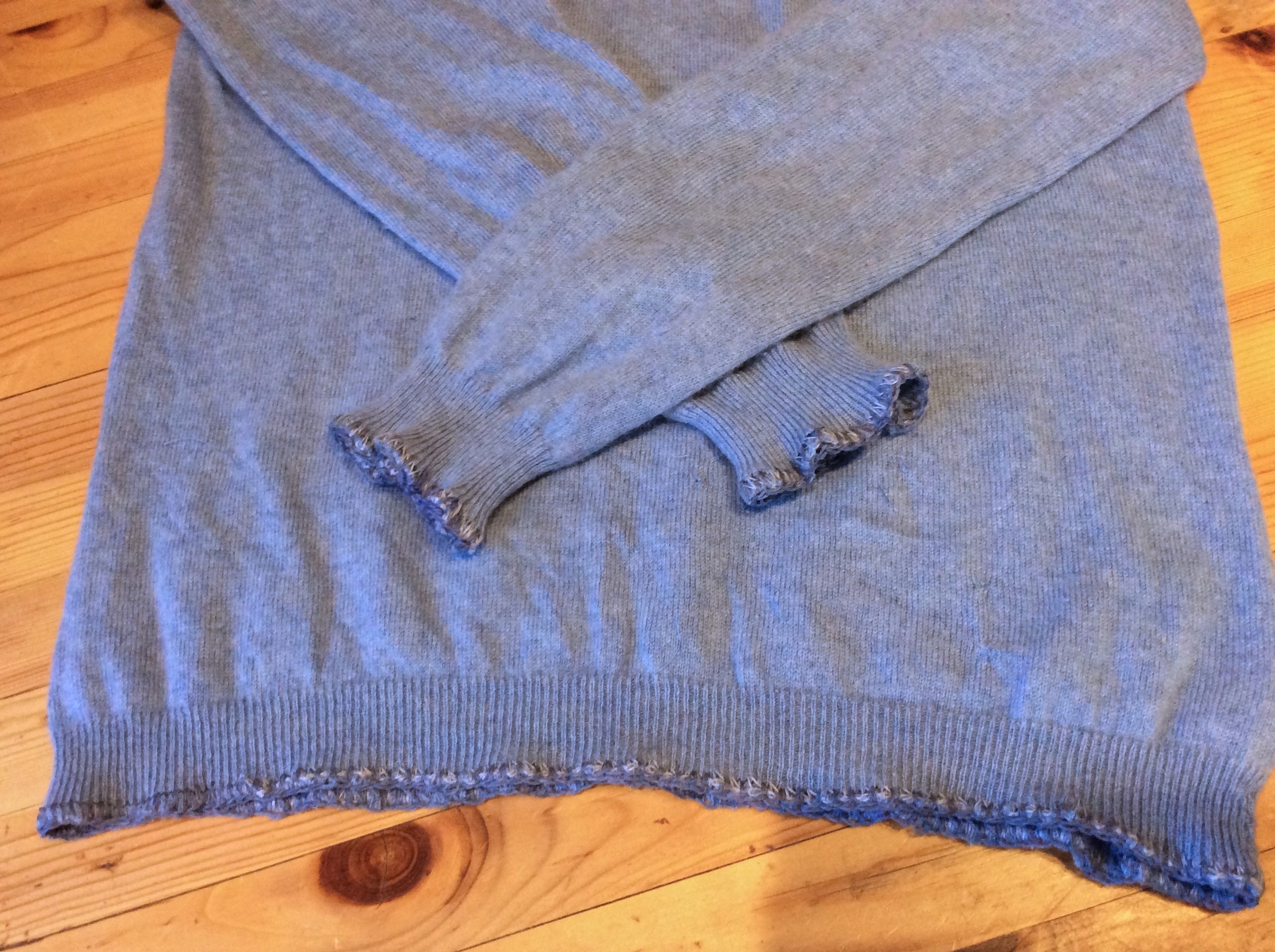
Moth-nibbled cashmere jumper

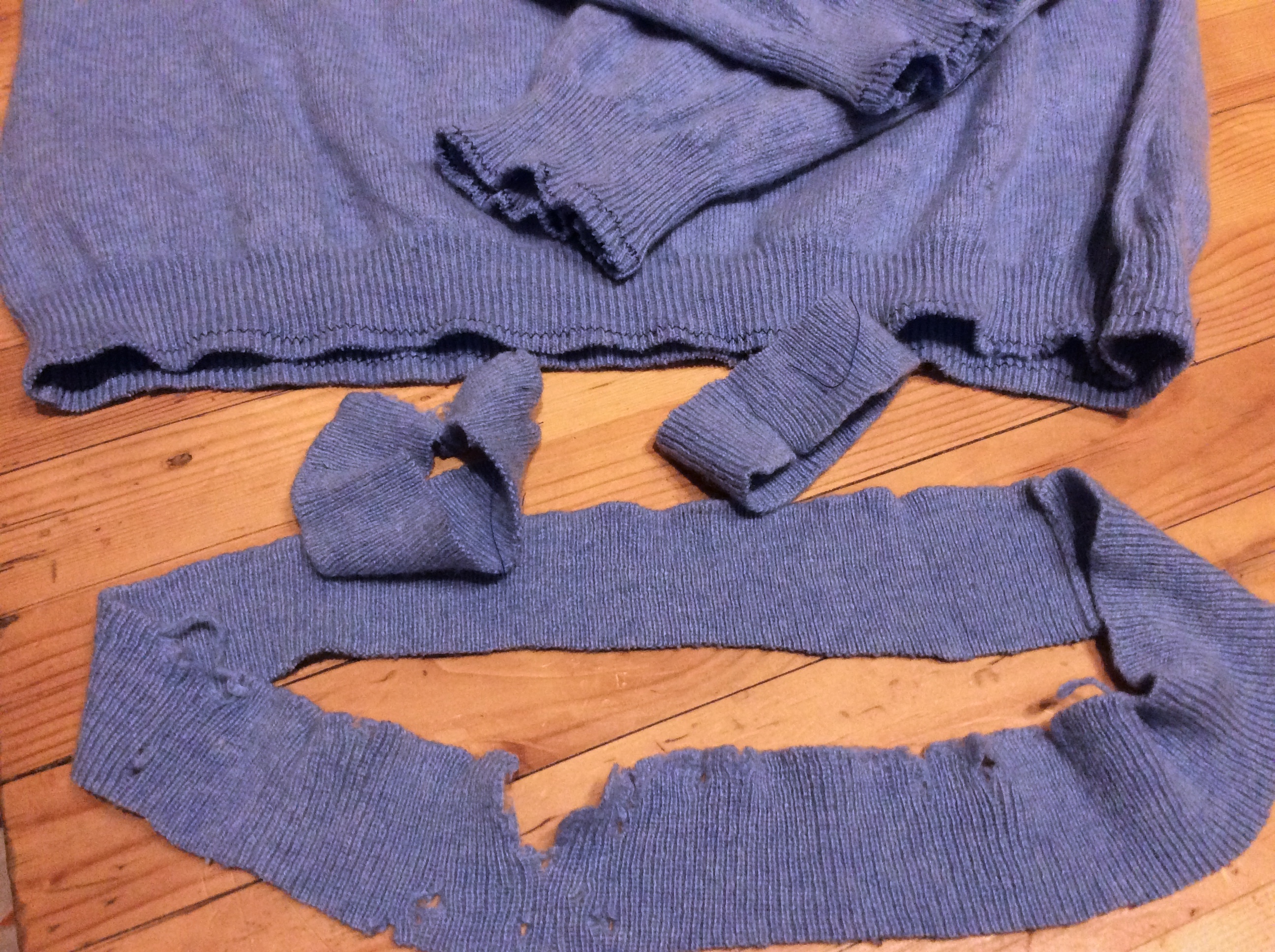
There were lots of holes around the hem, and on one cuff. Apart from that, there were very few holes on the body, arms or neck, just a few tiny nibbles. So I machine-stitched around the ribbing (thank you to my friends on the Fashion-on-the-Ration thread on the MSE forums for the idea!) above the worst of the damage, and cut the lower bits away, then stabilised the few mostly-tiny holes left by stitching all round them with cotton, tightening & tying-off. Both cuffs were stitched & cut off, for symmetry’s sake, even though one had been undamaged.

The worst of the damage cut away

Luckily I had some tiny sample skeins of cashmere in sympathetic colours, so I crocheted round the cut edges (straightforward double-crochet, or single for our American friends, basing each stitch just above the machine-stitched line) in one direction in a lighter blue, then the opposite way in a darker one. The last step was to felt round the edges slightly to bond the different yarns, by dipping them in hot water & soap & rubbing them gently between my fingers for a few minutes. Then it was washed & dried.

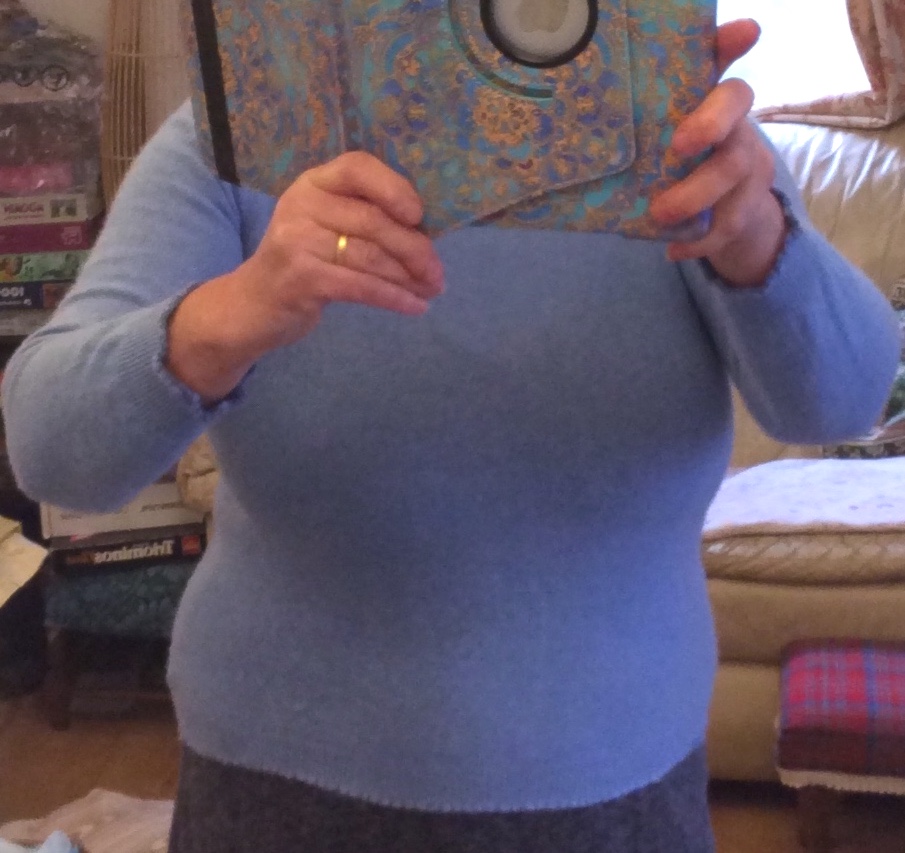
A bit more wearable…

I’m going to wear this one myself, mostly underneath other garments, and am perfectly happy that it now has what looks like a little lacy trim!

Just right for trudging up allotment paths!

As a “vintage” market trader, I’ve always mended worthwhile items to sell on, as well as for my own use, and have never considered wearing mended clothes to be a sign of moral deficiency. We have to stop shopping ’til we drop & throwing or giving stuff away after a couple of uses. Instead we need to buy carefully & consciously, and take proper care of what we have, wherever it come from. Part of taking care is mending when necessary, visibly or otherwise. Learning to mend could save you lots of money, or make it possible to buy things of a quality that would otherwise be out of reach. It’s a better use of precious time than endless binge-watching TV, and can even be combined with it once it becomes automatic.

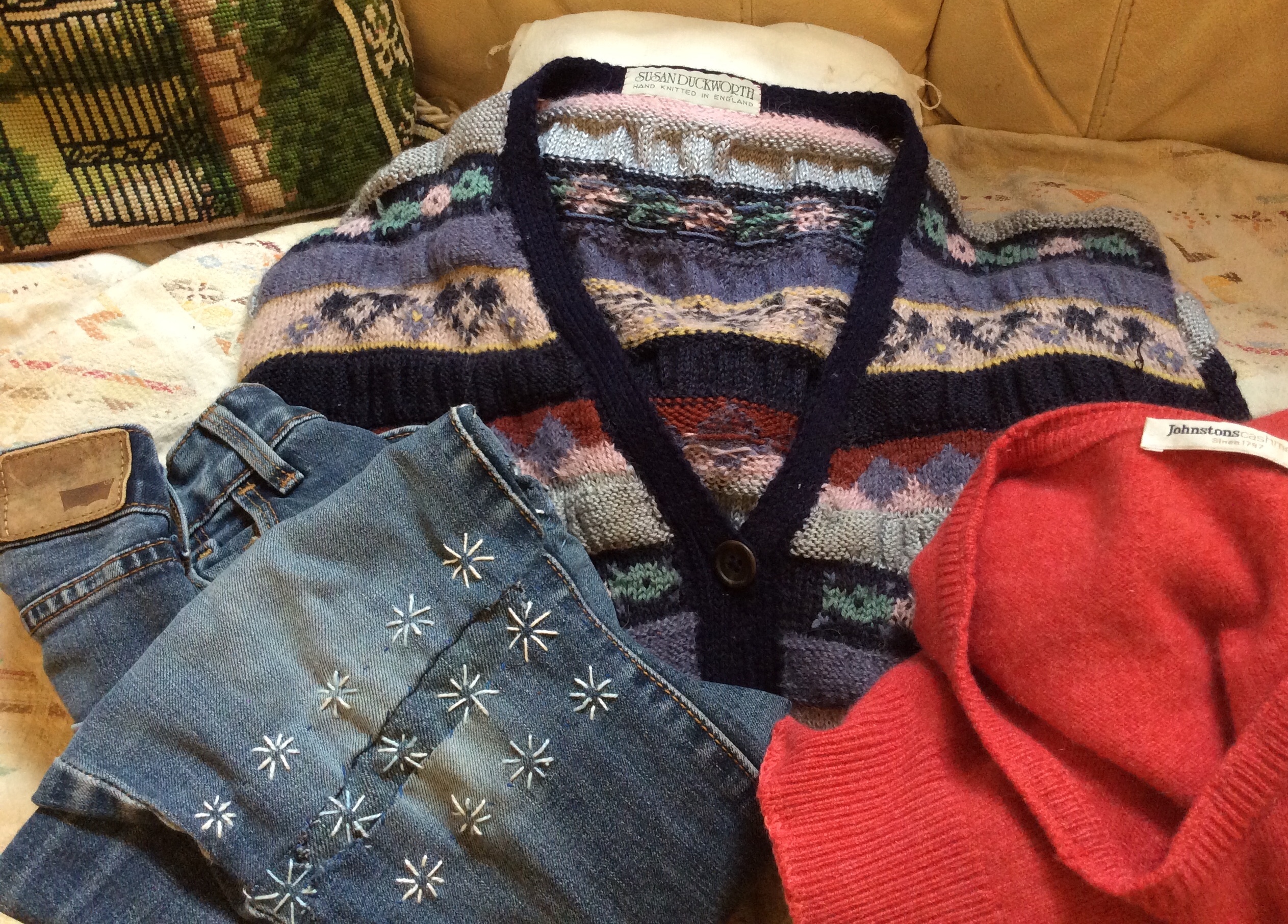
Darned vintage cardi by Susan Duckworth, visibly-patched 5 y.o. Levis & crochet-hemmed Johnstons of Elgin cashmere jumper.

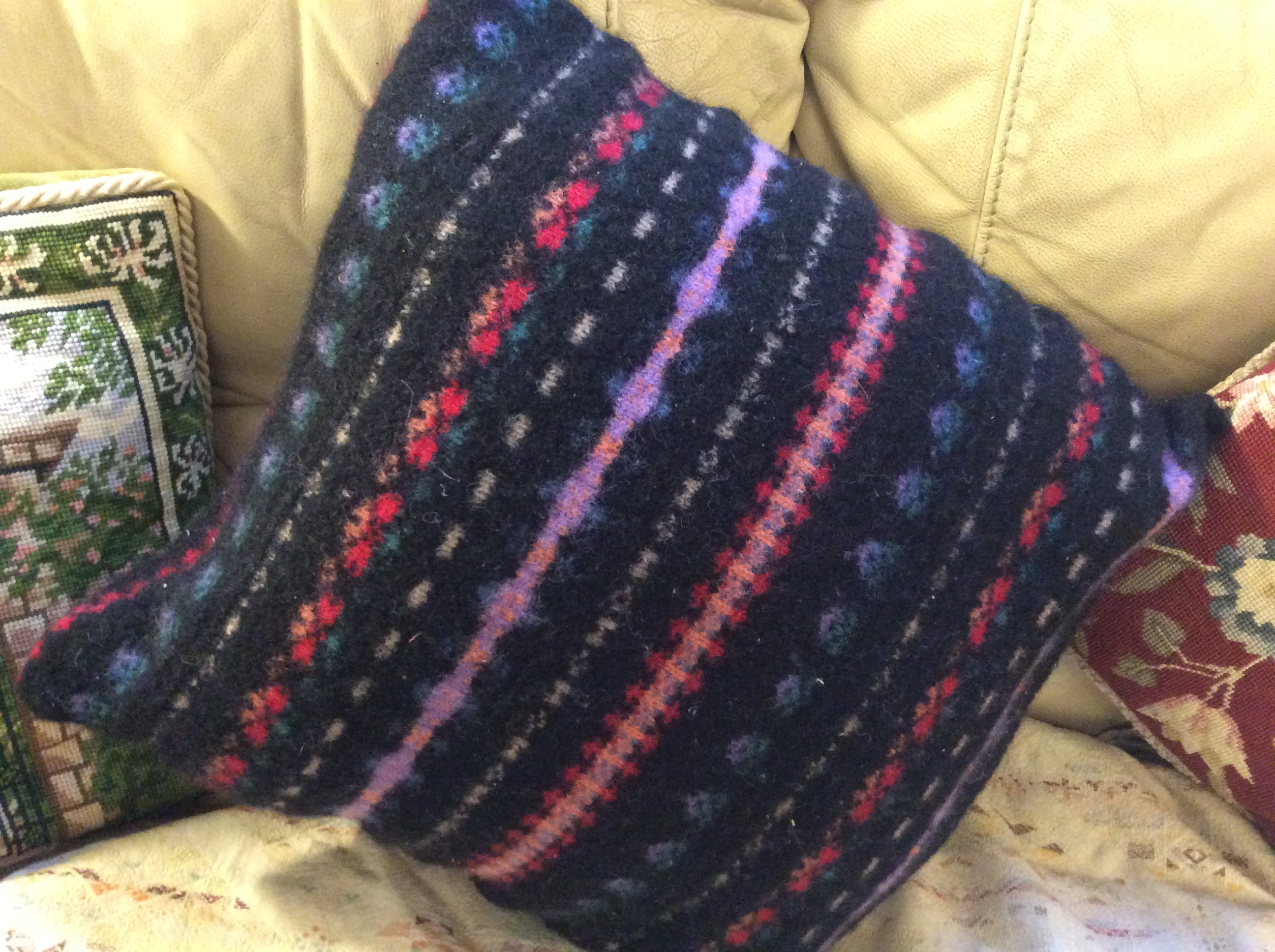
And when things go beyond the point of mend-abilty – upcycle. Felted jumpers make wonderful cushion covers!

A favourite jumper, shrunk & felted way past wearable, makes a cosy cushion…