New challenges!

A couple of days ago, at the recycling warehouse, they had a number of large (2.5m x 1.45m) !KEA pure linen curtains in a mustardy brown colour; I paid 50p each for five of them. Four were pretty much pristine & went straight off the next morning with a re-enactor friend (“A perfect medieval colour! This stuff is about £27 a metre new!”) But the fifth has some biro marks in the centre, which haven’t washed out. So I’m making myself a Japanese-style cross-over apron from it, with BIG pockets, decorated with some shibori I did on a course last year that’s been waiting for the right project.

Needless to say, there’s a reason why I’ve never done anything much with linen before; it’s tricksy stuff. Quite open-woven, with tendency to fray like mad, and it creases in seconds unless starched, which would be a bit OTT for a working apron. (But I know that with use, it softens & drapes like almost no other fabric woven from natural fibres does. And under the right circumstances, it can outlast entire dynasties – see the pleated linen dress/smock in the Petrie Museum.) I was also not sure that I’d really got my head around how the aprons actually work, so I drew up a pattern on brown wrapping paper & made up a rough toile from an old curtain lining that was just hanging around in the sewing room (actually the spare bedroom) waiting for something useful to do. The various “patterns” & instructions garnered from other makers’ blogs & Y0utube do actually work & make sense, it’s just I can’t always “see” things in 3D straight off.

Anyhoo, after idiotically forgetting to cut the “pattern” on the fold, deciding to overlock the edges & accidental centre seam for saftey’s sake and sticking pins into myself several times trying to place the pockets to best effect, I did have a wearable apron. But I wasn’t completely happy with the way that it hangs… partly down to my own shape, but partly because there’s not quite enough “body” to the fabric.
So I thought, should I have lined it? Which would be a considerable faff, making up a lining… hang on, where’s that toile? Needless to say, even adding in a pre-made lining isn’t going to be that easy… put that on hold for now.

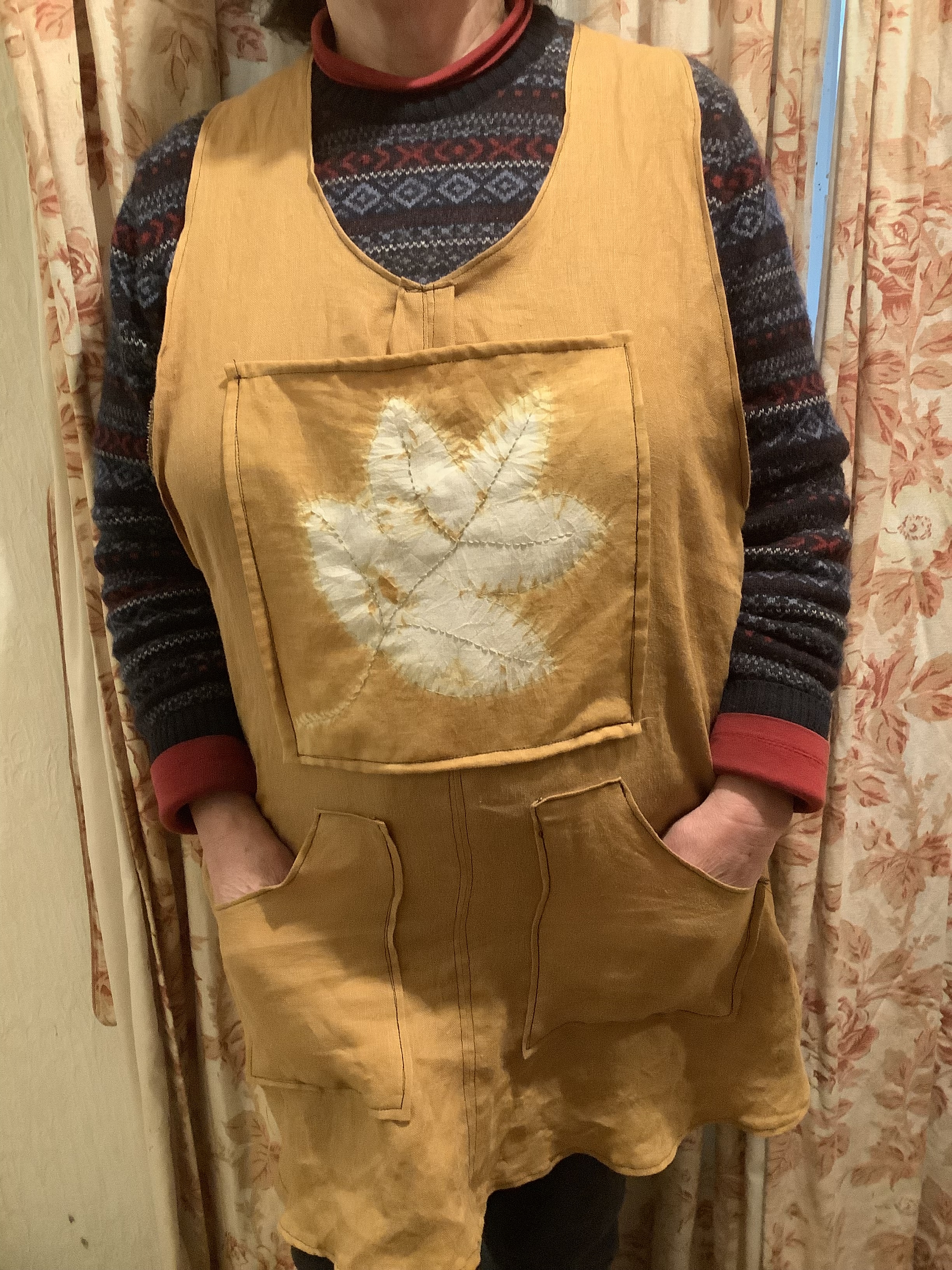
Luckily there was plenty of curtain left to cut out another one. I removed the shibori pocket from the first effort & adjusted the “pattern” a bit; made it a little longer & a bit narrower over the shoulders. Then fetched my 505 spray – this is a light spray-on glue, much loved by quilters for stabilising layers while you work – and smoothed the rest of the old curtain lining onto the linen, then cut it out, remembering to cut on the fold this time. I decided to leave the pockets on the first iteration and cut out some more from the left-over layered bits. Hemming the bits just seemed far too much like hard work, so I edged them with some herringbone tape left over from another project. I also stitched a few lines around the neck & straps, to keep the layers reasonably well together, knowing the pockets would sort out the lower half. Some beads & stitches found their way onto the shibori pocket, too.

So, here’s my new work apron:
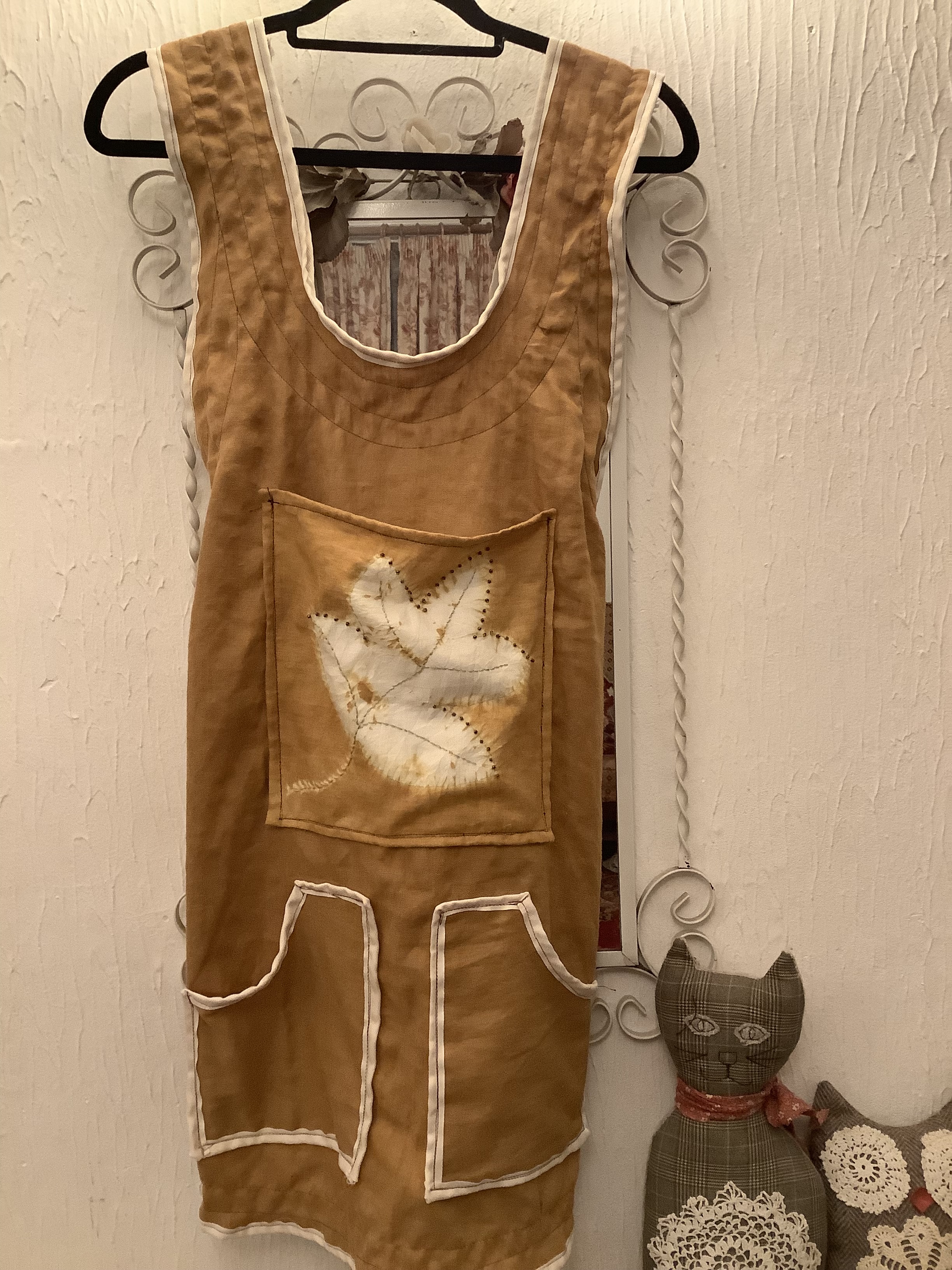
Which looks better on than hanging, but my assistant is off working on her knitting machine… So now, of course, I need to get that toile stitched into the first iteration, and I’ll have a fine work apron for my second allotment…

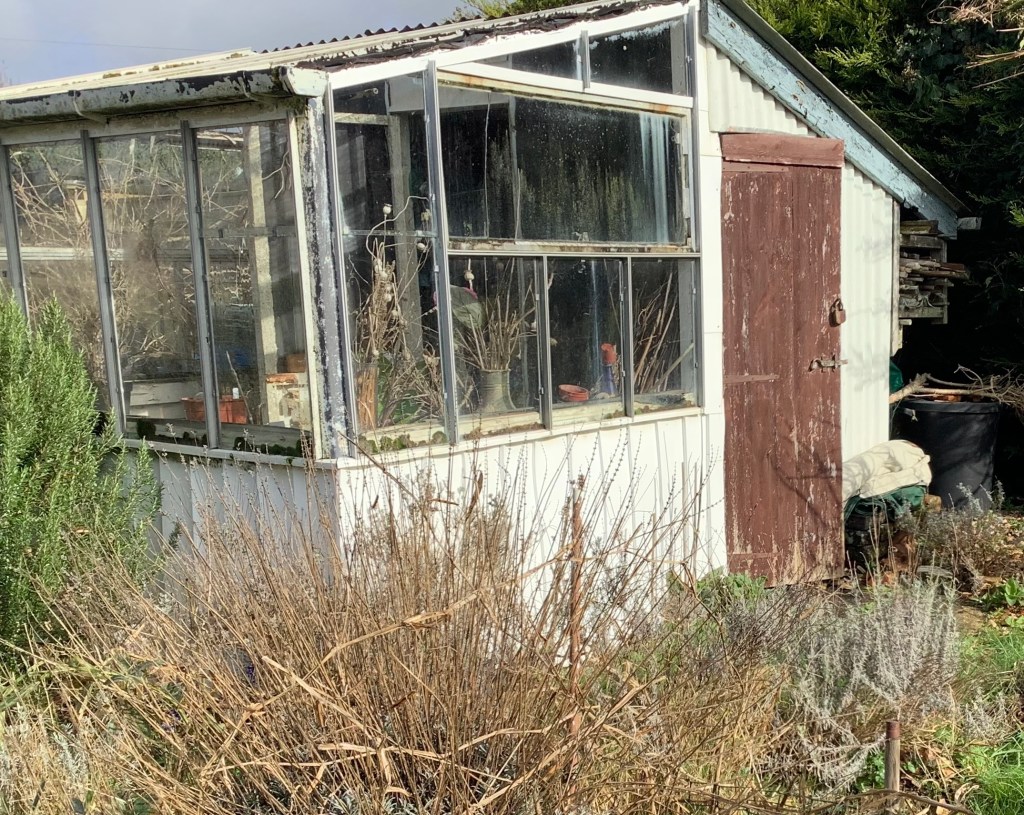
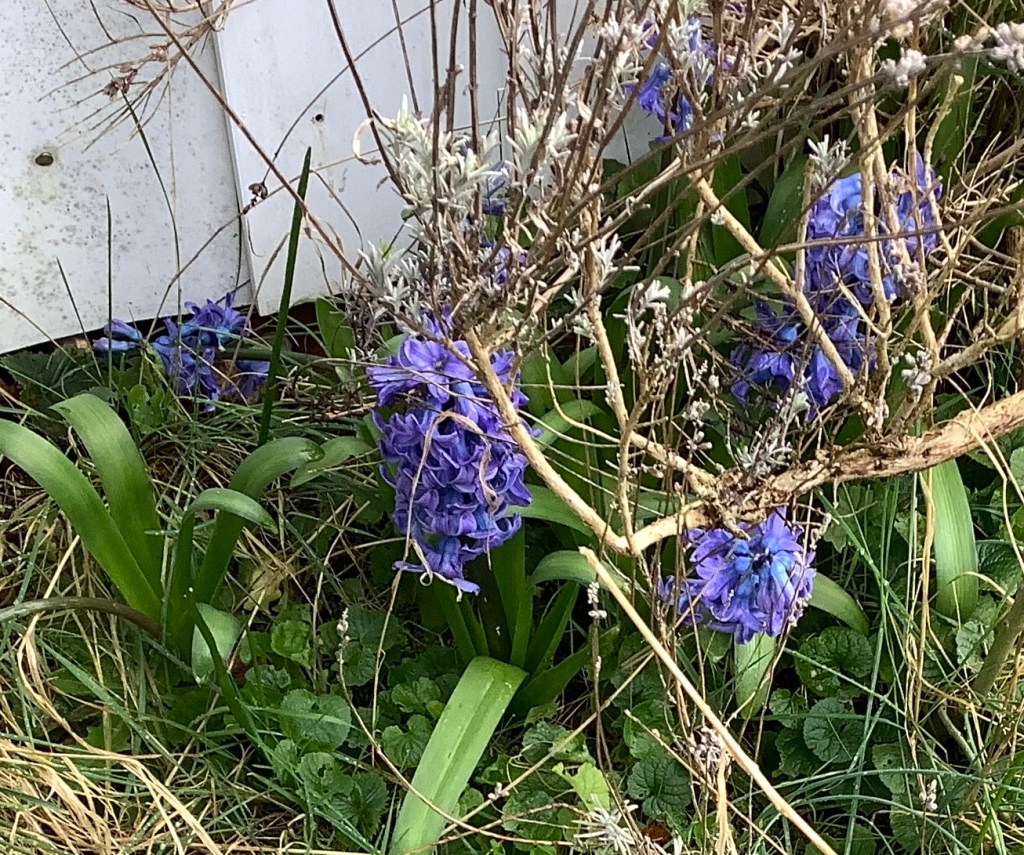
Second allotment? Yes, a half-plot has come free on the site just up the road from our home. It’s small but enchanting; it was a flat-dweller’s garden previously. There are some beautiful things there & I’ll try to keep as many of those as I can, although some are too big & hungry to continue grow alongside food plants and others will need to be moved into little areas set aside for pollinators. I’ll struggle to fit everything I want to grow in, BUT it has a wonderful half-greenhouse/half-shed that will allow me to grow far more of the tomatoes & chillis that we love, and it’s only a moment’s walk from our house. The other plot is a good mile away, which means driving if I have things to carry, and a twenty-minute walk each way when I don’t. Not to mention the constant onslaught of very determined agricultural weeds (brambles, blackthorn suckers, nettles, creeping buttercup) and pests (rats & rabbits, mostly) from the field boundary & ditch along the long edge. Also not mentioning my raspberries, which have gone feral & spread like a (very tasty) plague… So although I will miss that space, and have some crops in the ground (garlic, onions, beans) & perennial plants over there that I will miss, I will gradually wind that one down & eventually hand it over to someone with more grit!

Although I have yet to sign the lease & pay the rent, some of that rosemary will be flavouring our dinner tonight…

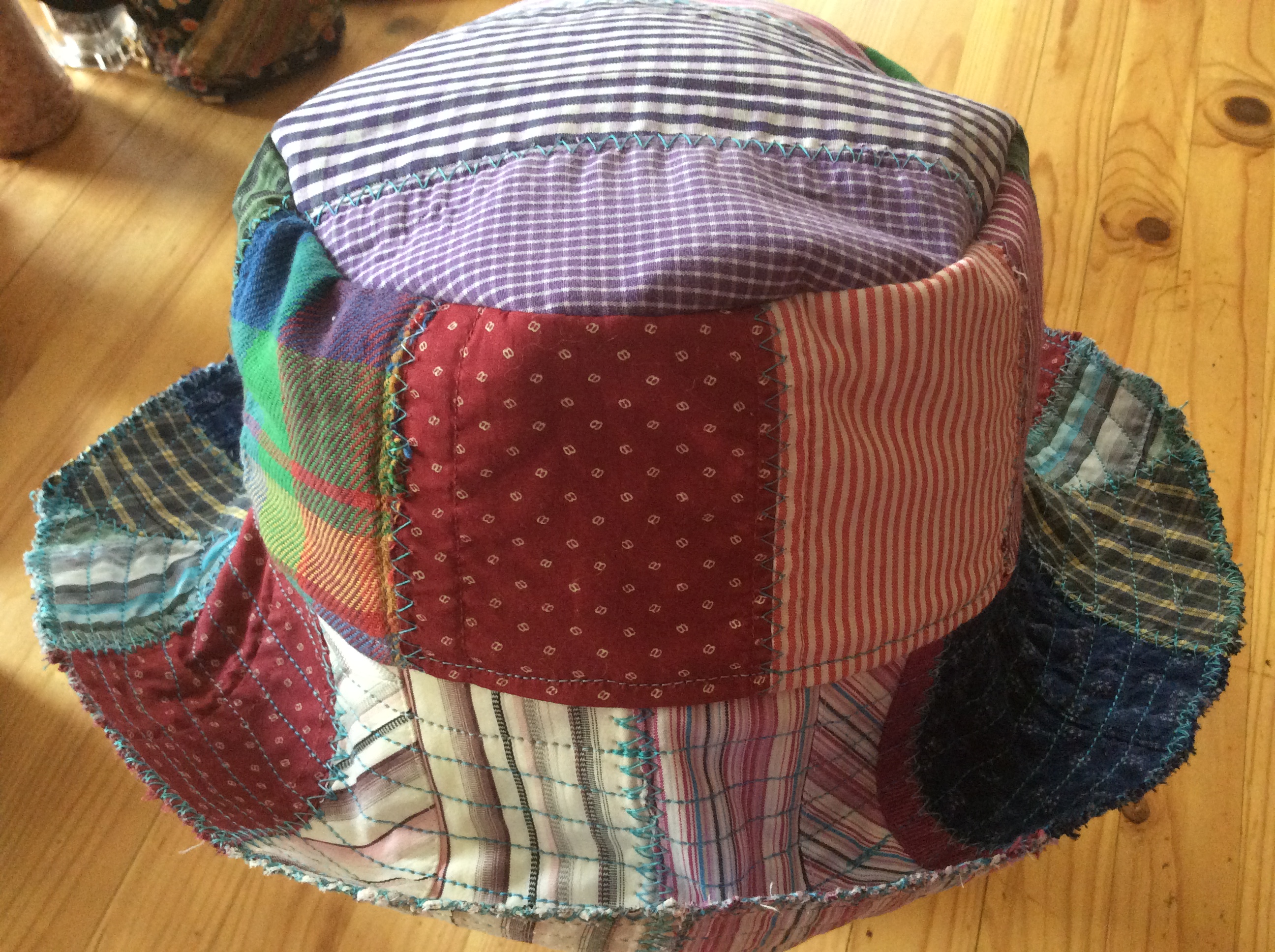
The Great Shirt Project strikes again…

For several years now, I’ve been working on a one-woman challenge: to find as many uses for old shirts as I can! Every quilter knows there’s a whole lot of good, still-useful fabric in a decent gent’s shirt, often in lovely colours and nicely understated patterns, and so many of them just get chucked away when something frays, or a button falls off, or the owner gets larger or just goes off that colour. I’ve been paying 50p for superb quality cotton or linen shirts down at the recycler’s warehouse-shop, chopping them up and using the fabric in little quilts, and weaving the side-seams into bags and rugs, and making hanging “pockets”, needle books, mending kits and laptop covers, to name just a few of the ideas that have occurred to me. A few of the resulting items have even been sold.

Yesterday I experimented with some cuffs; I’ve been steadily selling lavender hearts made from the embroidered bits of old stained table linen, but they are delightfully feminine when all’s said & done. I wanted to make something that a guy would be happy to hang in his wardrobe to make his clothes smell fresh & deter moths, too. So now I’ve invented the Lavender Cuff! Time will tell whether anyone will ever actually buy one, but it’s got to be worth a try…

Lavender-stuffed cuffs!

But the thing that I really, really wanted to make was a hat. It struck me some time ago that the stiffened bits of a formal shirt, i.e. the collars and cuffs, would be ideal for making a hat, if I could just get them joined together somehow. But before I had my big Pfaff machine serviced, all my attempts came to nothing; I broke a number of needles and wrecked several collars trying. It could always have been done by hand, but that might have taken rather a long time, so it didn’t happen.

Anyway, I tried again yesterday, and to my delight & surprise, I succeeded. The machine ran perfectly, I squared the collars & cuffs off to make even joins, and found an elegantly simple pattern to try (pattern & instructions here) and – it worked! I am now the proud possessor of a shirt-collar-and-cuff hat… This one’s a bit big; I made the bigger size because lots of hats feel too tight for me, so there’s another, slightly smaller, version in the making, but I’m actually really rather proud of it and will certainly wear it!

Collar-and-cuff hat!

Awesome…

OLYMPUS DIGITAL CAMERA


A few years back, there was a little shop in our town, in the same row that I tried running a shop in more recently. It was an absolute treasure trove of gorgeous vintage & antique household textiles & haberdashery, and the elderly lady who ran it was friendly, helpful, kindhearted (she often let me have part-skeins of embroidery thread from workboxes for, say, 10 or 20p) and inspirational. It featured in several national magazines as one of those quirky & glorious one-off emporiums that we British can excel at, given half a chance & reasonable business rents & rates. But sadly the rent & rates edged upwards as the proprietor’s health edged downwards, and eventually she had to give up. I always wondered what had happened to her stock… Quoting from elsewhere online:

“I’ve had an unexpected & astonishing weekend. It was our annual Folk Festival, when the population of our little town goes from 5,000 to about 20,000 for two days of colourful, musical mayhem. But I hardly got to see any of the processions, workshops, dances etc. because early on, I stumbled across an absolute treasure trove. There was a small market down one of the back streets, and someone  was selling off some old textiles etc. at very sensible prices. I’m “doing” a major festival as a trader later this summer & have been terrified I don’t have nearly enough good stock; things I’m proud to be rehoming at a profit, if you know what I mean. But I was able to pick up some very nice things at a very decent price, even if we’ll be eating beans for the rest of the month!

I got chatting to the guy selling them & eventually, after a bit of digging, it emerged that it was leftover stock from one of the little shops in town, one of my favourite-shops-of-all-time in fact, that stopped trading a few years ago when the proprietor became too elderly & ill to carry on. The end result is that I shall be talking to him later in the week about the rest of her leftover stock, which sadly has not been well-stored in the interim, but still has value of a kind, even if a fair bit of it isn’t saleable any longer. I actually think I’m very privileged to be handling some of these items; think lace baby bonnets going back to the early 1800s, hand-embroidered Victorian bloomers, 30s crepe-de-chine hankies edged with handmade lace – that sort of thing.”

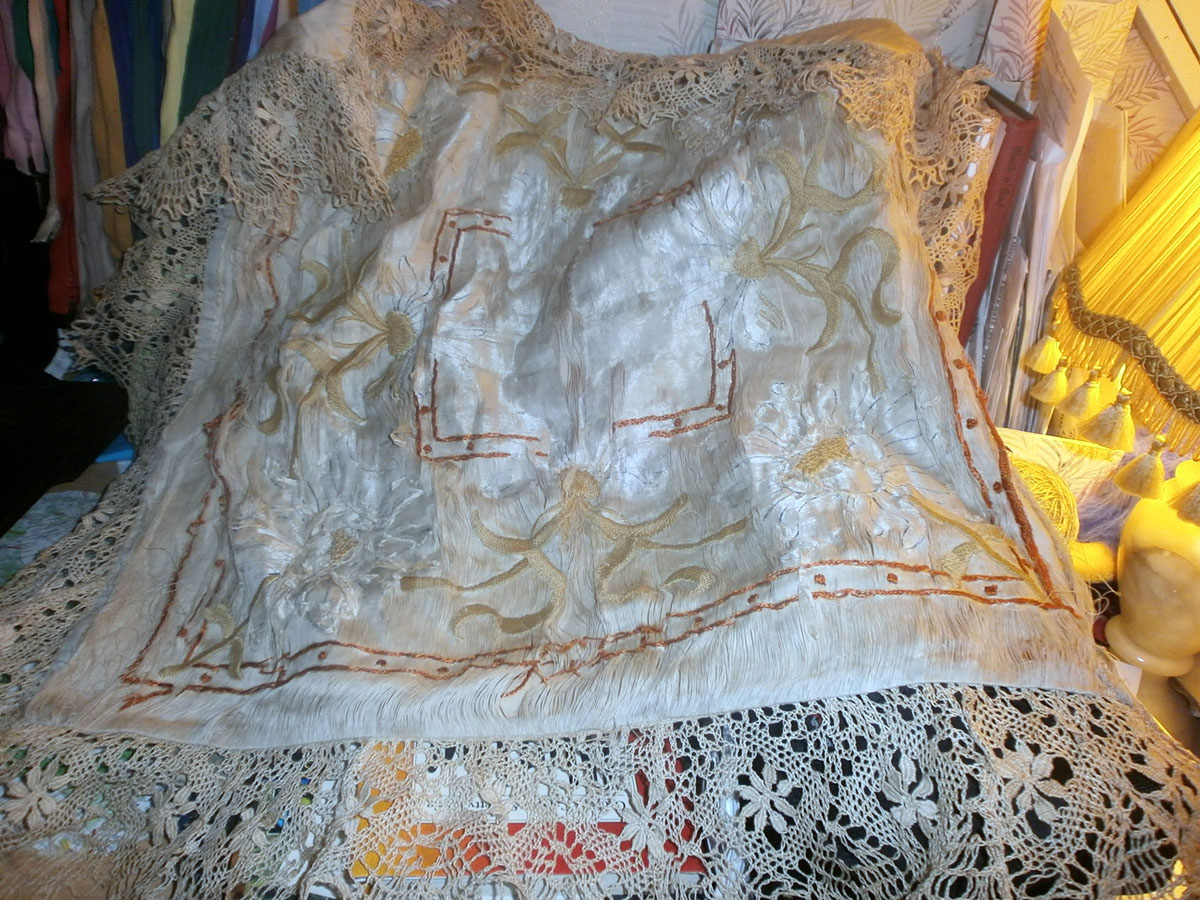
Some of it is literally shredding in our hands; for example the silk/glazed cotton/lace cushion cover above, which is most likely French (there’s another one, in even worse condition, with Souvenir de France embroidered on it. A good clue as to its origins, I feel!) where the cotton backing & lace are intact but the weft threads of the cover have just gone to dust; the warp threads are all that’s holding that embroidery together. The baby bonnet, which is the piece I recognised from the old shop, is also shredding to dust as it’s handled; several years crumpled into sealed black plastic binliners in a hot loft have not done much for the development of age-stains & mould spots, either. It’s a shame to touch it & hasten its decline and I feel quite inadequate to the task of trying to preserve what’s left in decent condition. But I suspect it would just end up at the Tip otherwise, if unsold. And I know that the old lady, and the untold hundreds of stitchers behind her, stretching back at least as far as 1800, would be far happier to see what remains of their exquisite work being used & admired, even if that means cutting it up to remake into something new, than made into J-cloths & used for wiping sinks.

So now I have a huge task before me; I need to learn as much as possible, in as short a time as possible, about lace, so that I don’t accidentally destroy or flog off for pennies, something wonderful that should remain intact & be properly preserved for posterity… It’s a great opportunity, but also a huge responsibility.

OLYMPUS DIGITAL CAMERA